Kitchen Exhaust Cleaning in Oshawa
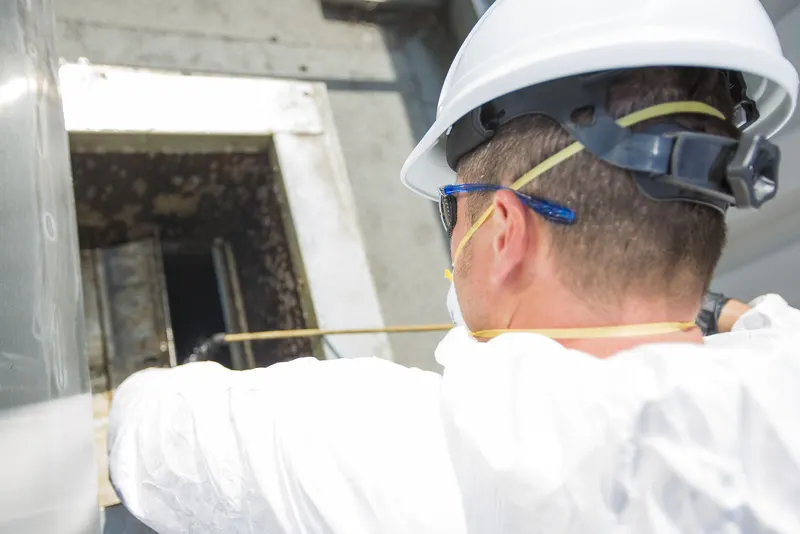
Kitchen Exhaust Cleaning in Oshawa is the cleaning of the grease-carrying duct that starts at the hood collar and ends at the roof: the horizontal run above the ceiling, the vertical riser, and the access panels that make each section reachable. Oshawa Hood Cleaning opens the run at every panel, cleans each section to bare metal, applies the NFPA 96 grease limit of 0.078 inches along the whole path rather than at the hood alone, and names every section on a signed certificate.
Horizontal run, riser, access panels: the three parts of the duct
The horizontal run leaves the plenum through the duct collar and travels above the ceiling toward the shaft. Grease settles on the bottom of the duct, piles up on the outside of every elbow where the air is thrown against the wall, and drops out wherever a transition slows the airstream. A run with two elbows can hold most of its deposit in those two corners.
The riser is the vertical section up to the fan. It drains, so whatever condenses on its walls runs back down and pools at the bottom of the turn. A riser looked at only from the roof reads clean while its base does not.
Access panels are sealed, removable openings in the duct wall. Without them a crew reaches an arm's length in from the collar and stops. Fitting compliant panels where a run is blind is part of the job, priced before the visit. The hood assembly is on the hood cleaning services page and the fan on the exhaust fan repair page.
Hood-only cleaning vs full-system cleaning: what an Oshawa inspector asks
The two scopes look the same from the kitchen floor and read very differently on paper.
| The question an inspector or insurer asks | Hood-only vs full-system: the hood-only answer | The full-system answer |
|---|---|---|
| Was the horizontal run opened? | No. The collar was wiped from below. | Yes, at every panel, with a photograph inside each one. |
| Was the base of the riser cleaned? | Not reached. | Yes. The pooled deposit at the turn is removed and photographed. |
| How many access panels does the run have? | Unknown. Nobody looked. | Counted on the walk-through, with missing panels quoted and fitted. |
| Where was the 0.078 inch depth checked? | On the canopy and plenum only. | Along the whole path: collar, elbows, riser base and fan inlet. |
| What does the certificate name? | The hood. | Each section cleaned, and each section that could not be reached, with the reason. |
| Which interval does this record satisfy? | None. The published interval refers to the system, not the hood. | The interval NFPA 96 publishes for the cooking volume. |
The published intervals are on the NFPA 96 page.
Kitchen exhaust cleaning services for Taunton Road and Harmony Road plazas with a shared riser
Oshawa Hood Cleaning documents each tenant's branch to the junction with the shared riser and quotes the riser itself to the landlord who owns it.
The plazas along Taunton Road and Harmony Road, and the older strips on Simcoe Street North, were built with several food units venting into one riser. Each tenant cleans its own hood and holds its own certificate, and the riser above loads from all three lines with nobody responsible for it.
The split is written down before the crew arrives. Each unit owns its canopy, plenum and branch duct up to the junction. The riser and the fan belong to the building. The tenant's certificate states where the branch ends and what condition the junction was in, and the riser quote goes to the property manager with proof of WSIB and liability coverage sent to both. Where the landlord declines, the tenant's record says so.
Where the 0.078 inch measurement is taken along an Oshawa duct run
NFPA 96 sets the acceptable grease depth at 0.078 inches and applies it to every surface the cooking air touches, so the depth is checked where deposit builds, not at the point nearest the kitchen.
Four points get measured on every full-system visit: the collar, where the airstream first slows after the plenum; the outside wall of each elbow, where grease is thrown; the base of the riser, where it drains to; and the fan inlet, the last surface before discharge and the one most often skipped. A reading at the canopy face says almost nothing about the other four.
A section with no panel is not measured and not certified. It goes on the record as not accessible, with the panel needed to fix it.
Top-rated commercial kitchen exhaust cleaning in Oshawa: what to look for
Commercial kitchen exhaust cleaning in Oshawa should be judged by whether the contractor can show the inside of the duct, because the outside proves nothing.
Photographs inside the run. Before and after, through each panel, dated.
A panel count on the quote. A contractor who has traced the run knows how many panels exist and how many are missing.
A certificate that names sections. Collar, horizontal run, elbows, riser, fan inlet, each on its own line, with unreached sections listed separately.
A riser plan for a shared building. The contractor should say who is being quoted for the shaft. If the answer is nobody, the shaft stays dirty.
Oshawa Hood Cleaning works to that standard across Oshawa, Courtice, Bowmanville and Newcastle. Coverage is on the areas served page, and Bowmanville has its own page at hood cleaning in Bowmanville.
How much does kitchen exhaust cleaning cost in Oshawa in 2026?
Oshawa Hood Cleaning prices a single-hood kitchen up to ten feet from $385 per visit and a multi-hood kitchen of two to four canopies from $725 per visit, with shared-riser and larger systems quoted on site after a free walk-through. The written quote comes back within 24 hours.
On a full-system job the duct sets the hours. Run length, elbow count, riser height and how many usable panels exist all move the figure. A long run across an institutional kitchen with three elbows and no panels is a larger one, and the panels are their own line on the quote.
Next step: call 289-274-5331 or request a written quote. Say whether the unit shares a wall with another kitchen and whether a duct panel has ever been opened. The other services are on the services page.
Kitchen exhaust cleaning in Oshawa: frequently asked questions
Who pays for the shared riser in an Oshawa plaza?
The building, in almost every lease. The riser and the fan are common elements owned by the landlord, and each tenant is responsible for its own hood and branch duct. Oshawa Hood Cleaning quotes the two separately and states on the tenant's certificate where the tenant's responsibility ends.
How many access panels does a duct run need?
Enough to reach every section. NFPA 96 expects the system to be accessible for inspection and cleaning along its length: a panel at the collar, one at each change of direction, and one at the base of the riser. Most Oshawa runs that have never been cleaned have one panel or none.
Does cutting in a new access panel damage the duct?
No. A compliant panel is a framed, gasketed opening that seals under the fan's suction and reopens at every future visit. The panel never fitted is the damage, because the section behind it stays loaded.
Can the duct be cleaned without disturbing the dining room ceiling?
Usually. The run sits above the kitchen ceiling and the panels are reached from the kitchen side or a service corridor. Where a run crosses above a dining room, as it does in some downtown Oshawa buildings, the tiles are lifted and replaced on the same overnight visit.
Is the 0.078 inch limit the same on the duct as on the hood?
Yes. NFPA 96 sets no lower expectation for the sections that are hard to reach. The depth that fails a plenum fails an elbow or a riser base, and those are where deposit is heaviest. The limit and the intervals are on the NFPA 96 page.